
Lea Projected Versus Actual Release
A projected date is a calculation based on facts known at a point in time. It begins with the judgment and sentence, whether terms run together or one after another, and credit for time already confined. It may then reflect earned deductions, forfeitures, restoration, program credit, parole action, other holds, and later court orders.
An actual release date records a completed event. For LCDC, the release/activity log supplies the physical date, time, authority, and destination. For NMCD, a discharge or release record can preserve a later completed status. A projected field cannot prove that staff processed the release or that another agency did not take custody.
Choose Lea Release Date Source
The right record depends on why and where the person is held. Pretrial means the case has not reached a final sentence. Such a detainee generally has no fixed release date; bond, recognizance, dismissal, trial, a plea, or a hold may control. A county sentence and a state-prison sentence use different credit systems.
| Custody situation | Best date source |
|---|---|
| Pretrial at LCDC | Court docket and signed order, followed by LCDC’s physical release log. |
| Sentence served at LCDC | Judgment, presentence credit, LCDC sentence computation, and release order. |
| NMCD state prisoner | NMCD search as a snapshot, then the judgment and time-computation record. |
| Federal prisoner | BOP locator and federal sentence record, with downstream-custody review. |
NMCD states it has no jurisdiction over county or city detention facilities. Do not use its search to calculate a county-only LCDC date. Likewise, the LCDC roster cannot predict the date for a person transferred to state prison.
Find Lea Projected Release Dates
Use documents in the order that builds the calculation. A public search result is convenient, but it is not the audit trail. Save exact labels rather than rewriting “projected,” “parole eligible,” or “sentence expiration” as release.
- Identify the current custodian and whether the person is pretrial, county-sentenced, state-sentenced, or federal.
- Obtain the signed judgment for each count and note concurrent or consecutive terms.
- Record presentence confinement credit awarded by the court.
- For NMCD, search by NMCD number or name and transcribe the exact public date label.
- For LCDC, request the sentence computation, any approved county good time, and the release order.
- Check for detainers, parole action, amended orders, forfeited credit, and recalculation.
- Verify the actual event later through the agency release record.
The NMCD offender-search page explains its scope and update cautions. Adult Prison data updates nightly, while Probation and Parole information updates in real time. NMCD asks users to allow 24 hours for recent prison movement.
Lea State Release Credit Rules
New Mexico’s Section 33-2-34 governs earned meritorious deductions for state prisoners. The current framework must be matched to the offense and effective law, not merely the degree of conviction. After presentence confinement is credited, the current maximum regular deduction is four days per month for a serious violent offense and 30 days per month for a nonviolent offense. Life terms and special provisions need separate analysis.
New Mexico law does not literally command every covered prisoner to serve 85 percent. The state Supreme Court’s calculation in State v. Rudolfo explains that the four-day monthly ceiling for a serious violent offense works out to about 86.85 to 100 percent of actual service. That is not a universal shortcut. Apply only deductions NMCD awarded under the proper legal version.
The official statute image below shows the earned-deduction source.
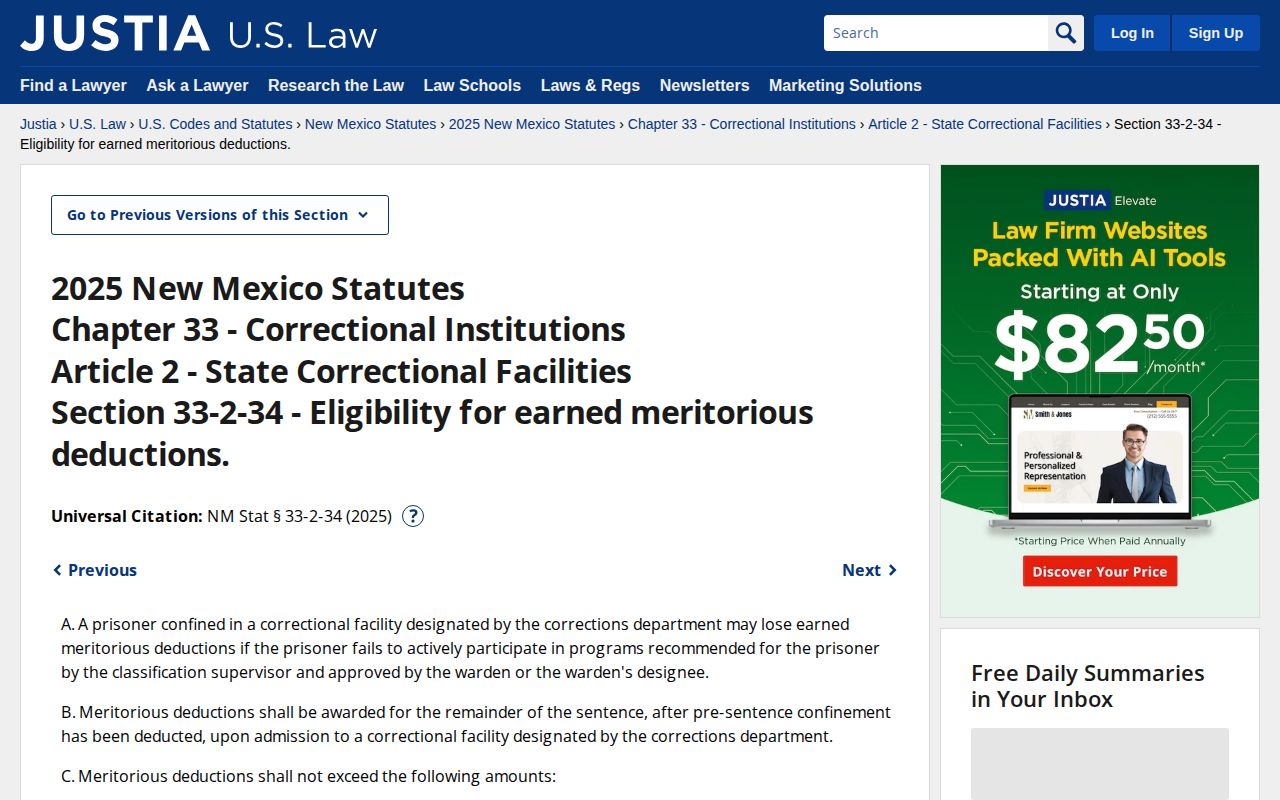
NMCD Offender Management Services keeps the time-computation record. Program achievements or conduct may support credit under the law, but a biography does not prove that credit was awarded. Request the computation sheet to see earned, forfeited, or restored deductions.
Lea County Jail Good Time
County-jail good time follows a separate law. Section 33-3-9 allows the sheriff or jail administrator, with approval of the committing or presiding judge, to award a sentenced county prisoner deductions for good behavior and industry up to one-half of the original sentence. It is discretionary and does not apply to pretrial detention as such.
The LCDC handbook adds a local detail: qualifying detainee workers may receive individual good time subject to court approval. It does not publish a uniform rate or promise. Ask for the named person’s approval and sentence computation. The statute also records forfeitures and limits credit against mandatory portions of specified driving sentences.
The county-good-time source below is distinct from the NMCD prison statute.
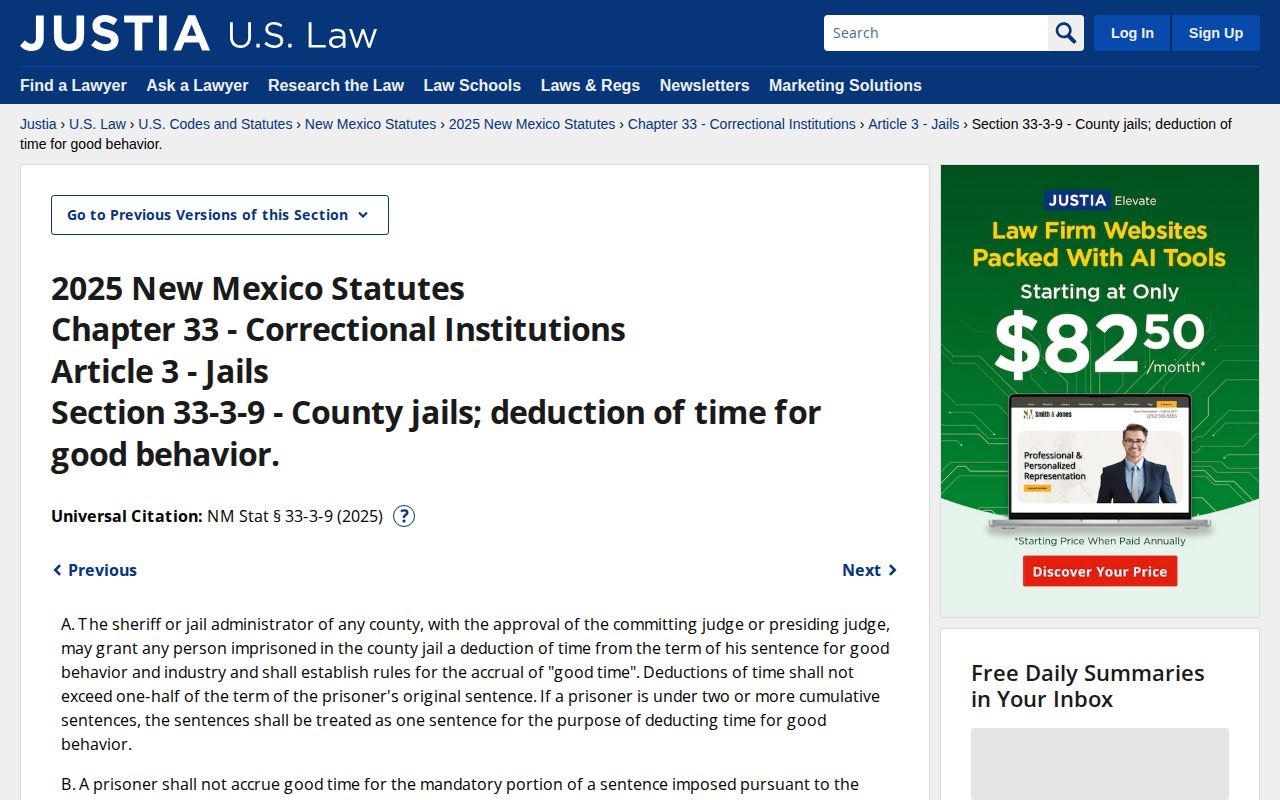
Do not import the state-prison formula into LCDC. No official Lea County source publishes a weekend-release rule or local calculator. The agency file and court approval decide the named calculation.
Lea Presentence Release Credit
Presentence confinement credit is separate from later earned deductions. Under Section 31-20-12, felony time held before sentence is credited day for day as the judgment provides. It should not be counted twice.
The statute view below supports that distinct starting credit.
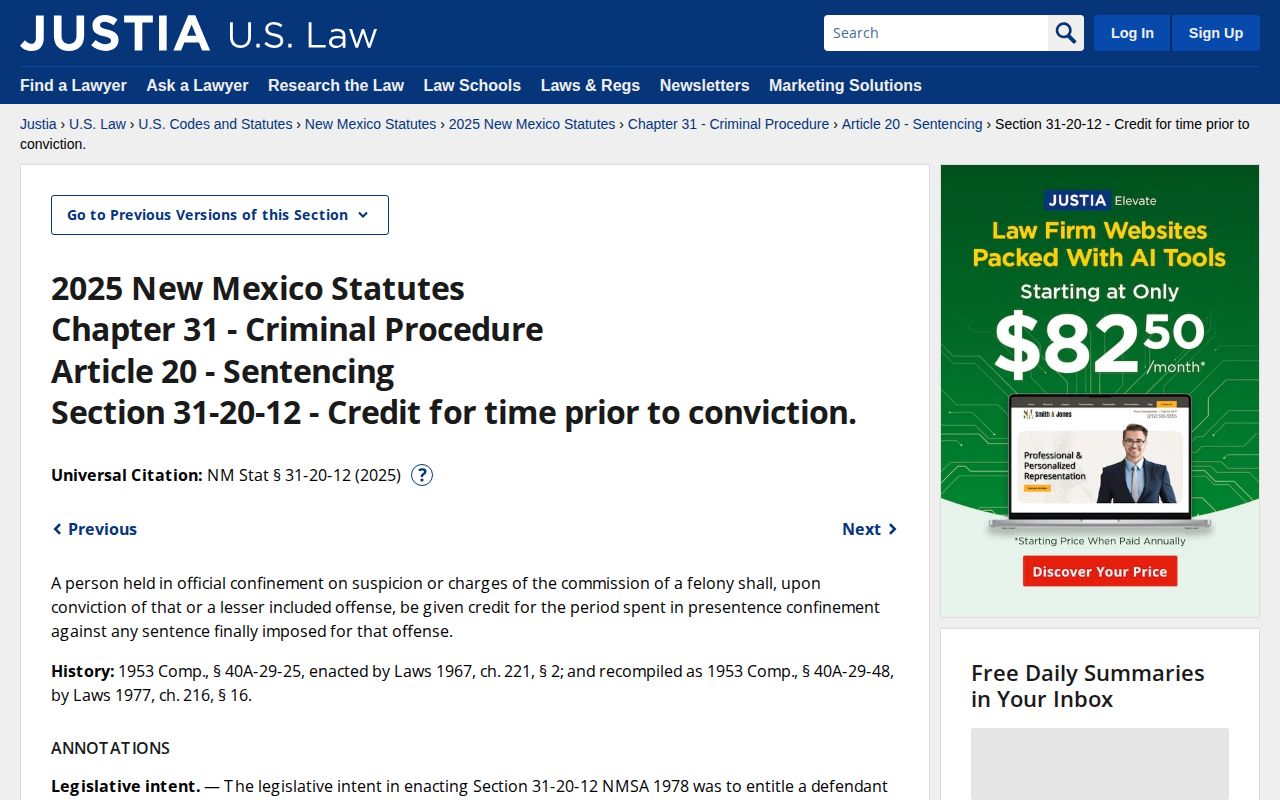
Read the signed judgment rather than estimating from arrest and sentencing dates. Another case, interrupted custody, or wording in the order may affect which days count. If the court and agency calculations differ, request each worksheet and ask them to reconcile the entries.
Why Lea Release Dates Change
A projected date moves when an input changes. Some changes shorten confinement; others extend it or route the person to another custodian. Parole eligibility is also not physical release. The Board may grant, deny, defer, or require an adequate release plan.
| Factor | Possible effect |
|---|---|
| Earned or restored deductions | May move a state estimate earlier when actually awarded. |
| Forfeiture or discipline | Can remove credit and move the estimate later. |
| Amended judgment or corrected credit | Changes the legal starting inputs. |
| Detainer or warrant | May cause transfer even when the current sentence ends. |
| Parole Board action and plan | May affect conditional release without proving discharge. |
| Administrative recalculation | Updates the public snapshot from the underlying record. |
A detainer is a notice that another authority may assume custody. It can make the end of one sentence differ from community release. Obtain the receiving agency and follow its record.
Confirm Lea Actual Release
For LCDC, request the release/activity-log entry and signed order. For NMCD, preserve the exact search label, then verify through the institution or assigned Probation and Parole office. NMCD states that Central Office, Constituent Services, and Records Bureau do not provide real-time release updates, so use the contacts the agency assigns for status verification.
New Mexico VINE may send a pending custody-change alert, subject to its service notice. Registration and limits are detailed on the VINELink Inmate Search page. An alert is not a discharge certificate. Parole is conditional community supervision; final discharge is later and is best shown by the Board’s final order and certificate after sentence and parole obligations end.
For a full named-person record chain, use the Lea County released-inmate lookup. Note: Keep the projected snapshot and final release record as separate dated facts.
Lea Parole Is Not Discharge
Physical release from prison on parole begins conditional community supervision. It does not mark the end of the sentence. Section 31-21-10 generally sets post-imprisonment parole periods by felony degree, with separate rules and exceptions for some offenses and life sentences. A signed set of conditions and an adequate approved plan can matter before physical release occurs.
The strongest proof that supervision ended is the Parole Board’s final order and certificate of discharge after the sentence and parole obligations are complete. Request both the prison release record and final discharge record when the distinction matters. One date marks departure from confinement; the later document can mark the end of state supervision.
Audit Lea Release Calculations
Build the audit by count. For each count, record the imposed term, whether it runs concurrently or consecutively, the presentence credit, and the legal version governing deductions. Then list only credits actually awarded. Add forfeitures, restorations, amended orders, and any other-hold information as separate entries rather than burying them in one estimated date. The NMCD time-computation sheet is the strongest state record for seeing which deductions were actually entered, lost, or restored.
Life and life-without-parole sentences do not fit a simple calculator. Neither do uncertain offense classifications or incomplete judgments. Use the sentencing court, NMCD Offender Management Services, and the current institution to resolve those cases. A public projected field is useful for orientation, but the computation sheet and judgment provide the record that can be checked line by line.
When an apparent error appears, send the exact field, screenshot date, NMCD number, and supporting court document to the responsible agency. Preserve the response. A technical disappearance from NMCD does not mean release, and the department expressly warns users not to make that inference.
Lea Release Date Chronology
For an LCDC case, place the court and jail entries side by side. The first line should quote the order of release, judgment, or sentence-credit entry with its filing date. The second should quote the LCDC release/activity log with the actual custody-ending time and destination. These dates may differ because legal authority can precede processing, transport, and other-hold review.
For an NMCD case, add the department computation and any Parole Board action. The judgment controls the imposed sentence, NMCD applies the lawful credits and forfeitures, and the Board controls eligible parole decisions. None of those documents should be replaced with a charge-based estimate.
If another agency has a detainer, add the receiving authority as a separate event. The end of LCDC or NMCD custody may then be a transfer rather than community release. This is common enough in Lea County to check because LCDC houses U.S. Marshals detainees and may also execute other lawful holds.
Recheck every estimate after a new order or credit decision.